In filter manufacturing, pleating quality directly determines filtration efficiency, dust holding capacity, and product consistency. Among the various pleating technologies available, knife pleating machines remain a cornerstone for producing precise, repeatable pleats in filter media ranging from automotive air filters to industrial HEPA cartridges.
This guide examines knife pleating technology from a production perspective, comparing semi-automatic and fully automatic configurations to help filter manufacturers select the right equipment for their scale, product mix, and budget.
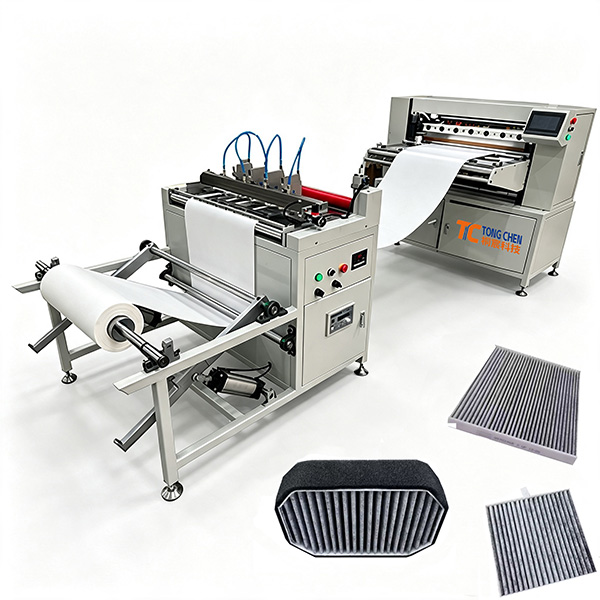
What Is a Knife Pleating Machine?
A knife pleating machine forms pleats by using a reciprocating blade (often called a pleating knife or wedge) that presses filter media against a stationary or counter-moving surface. The mechanical action creates sharp, defined creases that are then set through heat or pressure.
Compared with rotary pleating—which uses intermeshing rollers for high-speed production of uniform pleats—knife pleating offers distinct advantages in flexibility, pleat height range, and media compatibility. Modern servo-driven knife pleaters can achieve working widths up to 2,400 mm, pleat heights from 5 mm to 160 mm, and speeds approaching 200 pleats per minute.
The knife pleating process is particularly suited for:
●Automotive filter elements (air, oil, fuel, cabin)
●Industrial cartridge filters
●HEPA/ULPA filter media
●Multi-layer or composite filter media
●Small to medium batch production with frequent specification changes
Semi-Automatic Knife Pleating Machines
Overview
A semi-automatic knife pleating machine automates the core pleating action—the knife folding and shaping cycle—while requiring manual intervention for material loading, pleat stack removal, and certain changeover tasks. This configuration strikes a balance between investment cost and production capability.
Key Characteristics
Flexibility for varied production. Semi-automatic pleaters support adjustable pleat height, folding angle, and working speed. They handle a range of filter paper thicknesses and media types, making them suitable for factories that produce multiple filter specifications on the same line.
Lower capital and maintenance cost. With simpler mechanical structures and fewer electronic control components, semi-automatic lines require lower upfront investment and minimal daily maintenance. This makes them accessible for startup filter factories and small-batch workshops.
Stable pleating accuracy. Despite manual auxiliary operations, precision knife control systems eliminate the inconsistencies of manual folding, ensuring consistent pleat spacing and shaping quality.
Accessible operation. User-friendly digital control panels allow workers to adjust parameters quickly, without requiring specialized technical training for daily operation.
Best-Fit Scenarios
Semi-automatic knife pleating lines are the preferred choice for:
✔Small-batch customized filter production
✔New product trial runs and prototyping
✔Factories with diverse product lines and frequent specification switching
✔Medium-volume processing where full automation cannot be justified
Fully Automatic Knife Pleating Production Lines
Overview
A fully automatic knife pleating production line integrates material feeding, pre-conditioning (heating or humidifying), high-speed knife pleating, counting, and cutting into a continuous, unmanned workflow. These systems are engineered for manufacturers pursuing high-volume standardized production.
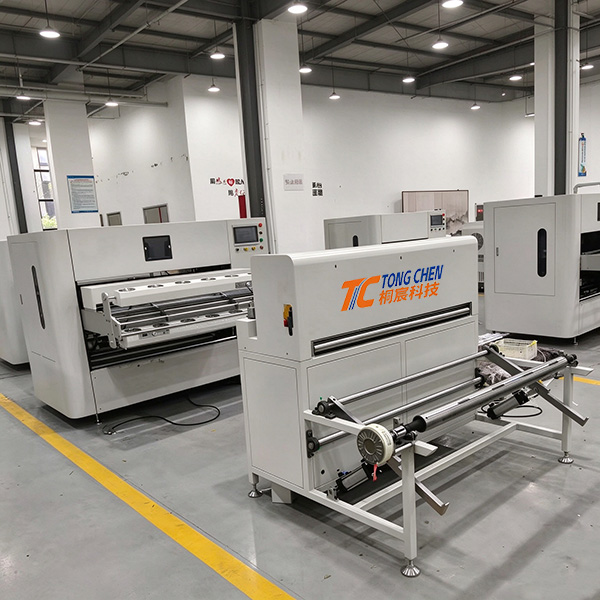
Key Characteristics
High-speed continuous output. Automated material handling and servo-driven pleating achieve production speeds significantly higher than semi-automatic models—typically two to three times the output for comparable pleat specifications. Some CNC knife pleaters reach 400 pleats per minute.
Exceptional product consistency. CNC precision control ensures every pleat has identical height, spacing, and folding angle. This uniformity maximizes media utilization and stabilizes filtration performance, which is critical for export-grade filter products.
Reduced labor and material waste. No manual feeding or unloading is required during production, lowering labor costs and eliminating contamination or damage from human handling. Intelligent material feeding and precise cutting optimize media usage and reduce waste.
Intelligent parameter management. Modern full-auto lines support one-key parameter switching for different filter models, with touchscreen interfaces for setting pleat height, feed length, and speed. Fault self-diagnosis and automatic stop functions further reduce downtime.
Best-Fit Scenarios
Fully automatic knife pleating lines suit:
✔Large filter factories with stable, high-volume orders
✔Standardized mass production (automotive PU filters, air filters, oil filters)
✔Export-oriented manufacturing requiring strict consistency
✔Long-term production runs where labor and material savings offset higher initial investment
Key Differences at a Glance
| Criterion | Semi-Automatic | Fully Automatic |
|---|---|---|
| Production efficiency | Medium-speed, batch-oriented | High-speed continuous output (2–3× semi-auto) |
| Flexibility | Excellent for varied specs and frequent changeovers | Best for fixed, standardized batches |
| Initial investment | Lower | Higher |
| Maintenance cost | Lower, simpler maintenance | Higher initial, but lower per-unit over time |
| Labor requirement | Manual feeding/unloading | Minimal manual intervention |
| Product consistency | Good | Excellent (CNC-controlled) |
| Best for | SMEs, custom orders, trials | Large factories, standardized mass production |
Selection Criteria: Which Line Fits Your Factory?
Choose semi-automatic if you:
- ✔Operate a small or medium filter manufacturing business
- ✔Focus on customized, small-batch, or multi-variety orders
- ✔Have a limited equipment budget and prioritize flexibility
- ✔Need to balance cost and capability during early-stage expansion
Choose fully automatic if you:
- ✔Run large-scale, stable production orders
- ✔Target standardized export filter markets
- ✔Pursue long-term efficiency and low per-unit cost
- ✔Can justify the higher initial investment through labor and material savings